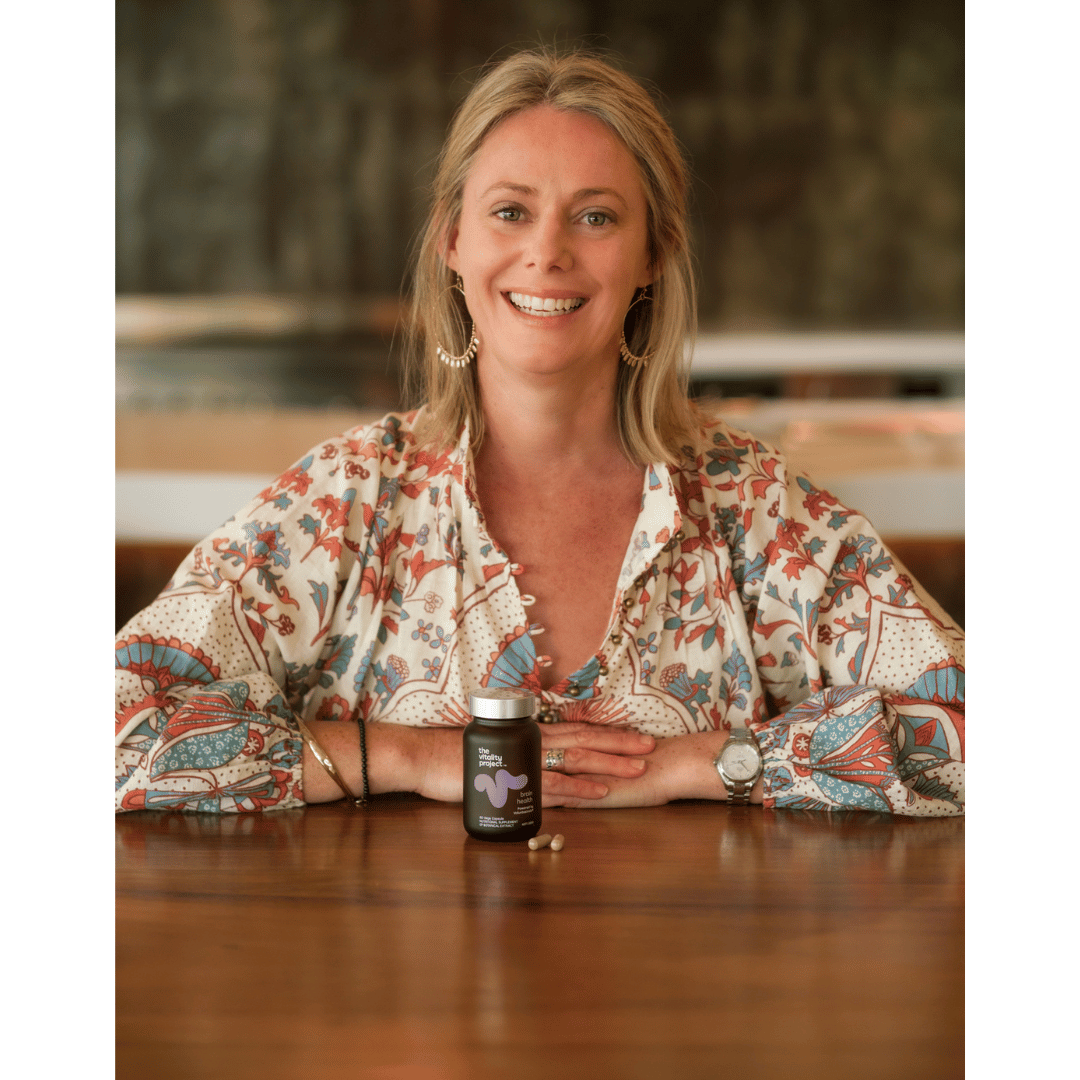
Journal #17. Flavonoids, sound and cognitive performance
Flavonoids, sound and cognitive performance
Flavonoids, Binaural Beats and Colourtation: Different Ways to Support a Better-Performing Brain
Taking care of your brain isn't just about what you put into your body. It's also about how you manage stress, stimulation and recovery.
Nutrition, sleep, movement and the way we respond to pressure can all influence how well our brains perform.
At The Vitalogy Project, we're particularly interested in approaches that help support cognitive performance from different directions — which brings together three seemingly very different things:
Flavonoids. Sound. And colouring.
So what could they possibly have in common?
Flavonoids: Supporting the Brain From Within
Flavonoids are naturally occurring compounds found in colourful fruits, vegetables and plants, including berries, citrus, tea, cacao and chamomile.
They've attracted significant scientific interest because of their antioxidant and anti-inflammatory properties and their potential role in supporting brain function.
This is also the science that originally led us to develop Brain Health, our proprietary combination of neuro-flavonoids derived from cacao, German chamomile and citrus.
But supporting cognitive performance isn't simply about nutrition.
What we do with our brain matters too.
Binaural Beats: Can Sound Influence Your State of Mind?
Binaural beats are an interesting example.
When slightly different sound frequencies are presented separately to each ear through headphones, the brain perceives an additional rhythmic beat corresponding to the difference between those frequencies.
Researchers have explored whether listening to different binaural beat frequencies may influence things such as relaxation, attention, anxiety and sleep.
One area of particular interest is alpha activity, commonly associated with relaxed wakefulness.
And this is where we recently discovered an interesting connection.
Meet Dr Stan Rodski
Dr Stan Rodski is a cognitive neuroscientist who has spent more than 30 years working in areas including stress, peak performance and brain science.
His work has included corporate stress programs, education and high-performance sport — and more recently has focused on a very modern problem:
How do we help an overstimulated brain change gears?
Stan uses a simple analogy.
Think of your brain like the gears in a car.
When pressure increases, your brain needs to change gear to respond. But when that pressure disappears, ideally it needs to change back again.
The problem comes when we remain in that high-alert state long after we need to.
Stan became interested in ways we might deliberately help the brain transition from a more stimulated state towards a calmer one.
That led him to sound — and also to something surprisingly simple.
Colouring.
From Binaural Beats to SoundScience
Stan and the Colourtation team have developed SoundScience, an audio program designed to complement their stress-management approach.
It combines sound designed around alpha-wave relaxation with another technique Stan has spent years investigating: focused colouring.
Rather than seeing sound as some kind of instant “brain hack”, we think the more interesting idea is how it can be incorporated into a broader ritual designed to reduce stimulation and encourage relaxation.
✔︎ Headphones on.
✔︎ Phone away.
✔︎ A simple task.
✔︎ Fewer distractions.
And that's where Colourtation comes in.
Why Colouring?
Stan developed the Colourtation Method around three deceptively simple principles:
Pattern. Repetition. Focus.
Instead of asking an already overloaded brain to process even more information, colouring gives it one contained task.
✔︎ Choose a colour.
✔︎ Follow the pattern.
✔︎ Stay within the lines.
✔︎ Repeat.
Stan's early research involved stressed executives undertaking a four-week stress-management program. One group used traditional mindfulness-based techniques while another incorporated the Colourtation method alongside them.
Participants were monitored physiologically during the program, and Stan reported stronger and more sustained stress-management improvements in the Colourtation group.¹
Perhaps just as interesting was adherence.
People actually continued doing it.
And that matters, because even the most sophisticated stress-management technique isn't particularly useful if we don't use it.
What Does This Have to Do With HRV?
This is where Stan's work became particularly interesting to us.
One of the physiological measures associated with his stress research is Heart Rate Variability — HRV.
Despite the name, HRV isn't primarily about how fast your heart beats.
It measures the tiny variations in time between individual heartbeats.
Those variations can provide useful insight into the activity of our autonomic nervous system and how our body is responding to factors such as stress and recovery.
HRV can be influenced by many things — including sleep, exercise, illness, alcohol, age and stress — so a single number shouldn't be viewed as a simple score of how “healthy” or “stressed” you are.
It's the patterns and changes over time that make HRV particularly interesting.
And that's something we're now exploring ourselves.
Our Next Step at The Vitalogy Project
We're delighted to now be working with Dr Stan Rodski on upcoming research involving Brain Health Performance Supplement and HRV.
Our previous observational research into Brain Health produced some fascinating self-reported changes across measures including mental energy, concentration, memory, brain fog, burnout and sleep quality.
Now we want to explore another question.
Can an objective physiological biomarker such as HRV add another layer to our understanding of stress, recovery and cognitive performance?
We don't know the answer yet.
And that's precisely why we're doing the research.
Ask the question. Measure it. See what the data tells us.
We'll be sharing more as the project develops.
In the Meantime, Try a Different Kind of Brain Reset
There's something rather appealing about the simplicity of Stan's approach.
We spend so much time trying to optimise our brains by adding more.
→Another app.
→Another podcast.
→Another productivity tool.
→Another screen.
Perhaps occasionally we should try the opposite.
✔︎ Give your brain less.
✔︎ Put your phone away.
✔︎ Take a Colourtation page and some coloured pencils.
✔︎ Put on Stan's SoundScience audio through your headphones.
✔︎ And spend 10–20 minutes simply colouring.
❌ No emails.
❌ No scrolling.
❌ No multitasking.
Just pattern, repetition and focus.
Then notice how you feel.
Sometimes supporting a better-performing brain isn't about asking it to work harder.
It's about giving it permission to change gears.
Discover Colourtation + SoundScience
Developed by cognitive neuroscientist Dr Stan Rodski, Colourtation combines purpose-designed colouring patterns with focused attention, while SoundScience adds an audio component designed to support the relaxation experience.
EXPLORE COLOURTATION & SOUNDSCIENCE →

Support Your Brain From Within
Brain Health combines our proprietary blend of cacao flavonoids, German chamomile flavonoid and citrus bioflavonoids, developed to support cognitive function and performance.
The Vitalogy Project is currently collaborating with Dr Stan Rodski on upcoming HRV research.
References
-
Dr Stan Rodski, Colourtation Research — Colourtation.
-
Wu L, Sun D. Adherence to Mediterranean diet and risk of developing cognitive disorders: An updated systematic review and meta-analysis of prospective cohort studies. Scientific Reports. 2017.
👉 Learn more about Brain Health.